They give their best
to an equal.
I don't take your horse and hand it back fixed. I teach you to become your animal's equal — a complementary partnership they respect — because that relationship is what pushes an animal to everything it can be. Fair warning: you'll put in the work.
Watch how Scotch works with me.
The maneuvers — the stop, the side pass, the turns — are the skills everyone waits for the saddle to train. But watch Scotch: ears on me, soft eye, a thousand pounds choosing to move as I move, held to an inch or two. No rope. No halter. Nothing between us but the relationship.
What you're actually seeing.
Every session gets read frame by frame. These three sequences carry the argument — including what Scotch isn't doing: no lead, no tension, no lure.
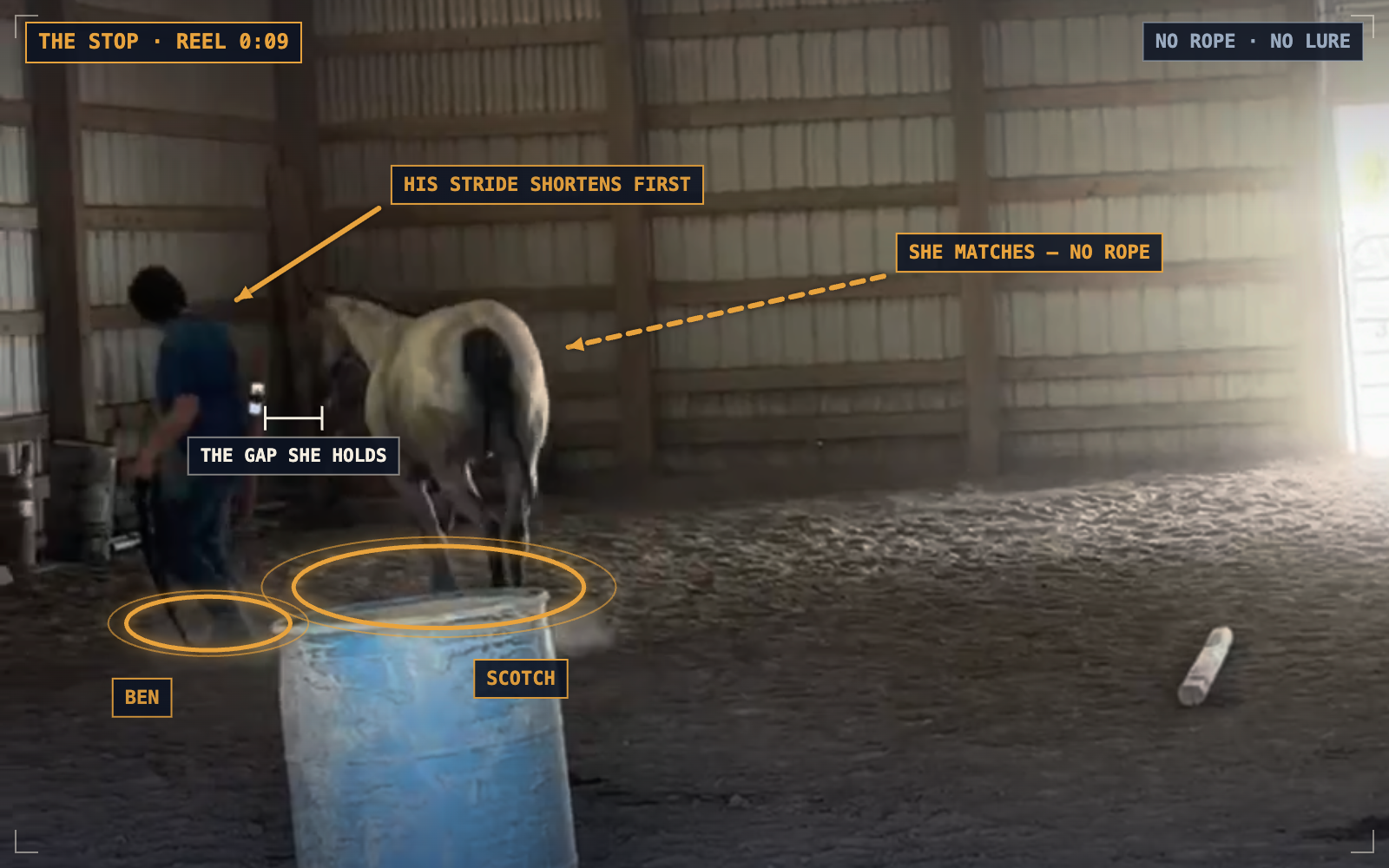
Momentum transfer — the stop
His stride shortens; hers shortens a beat later; the halt lands with the same gap she held at the walk. No rope between them — and the treat arrives after the stop is finished. Payment, not a lure.
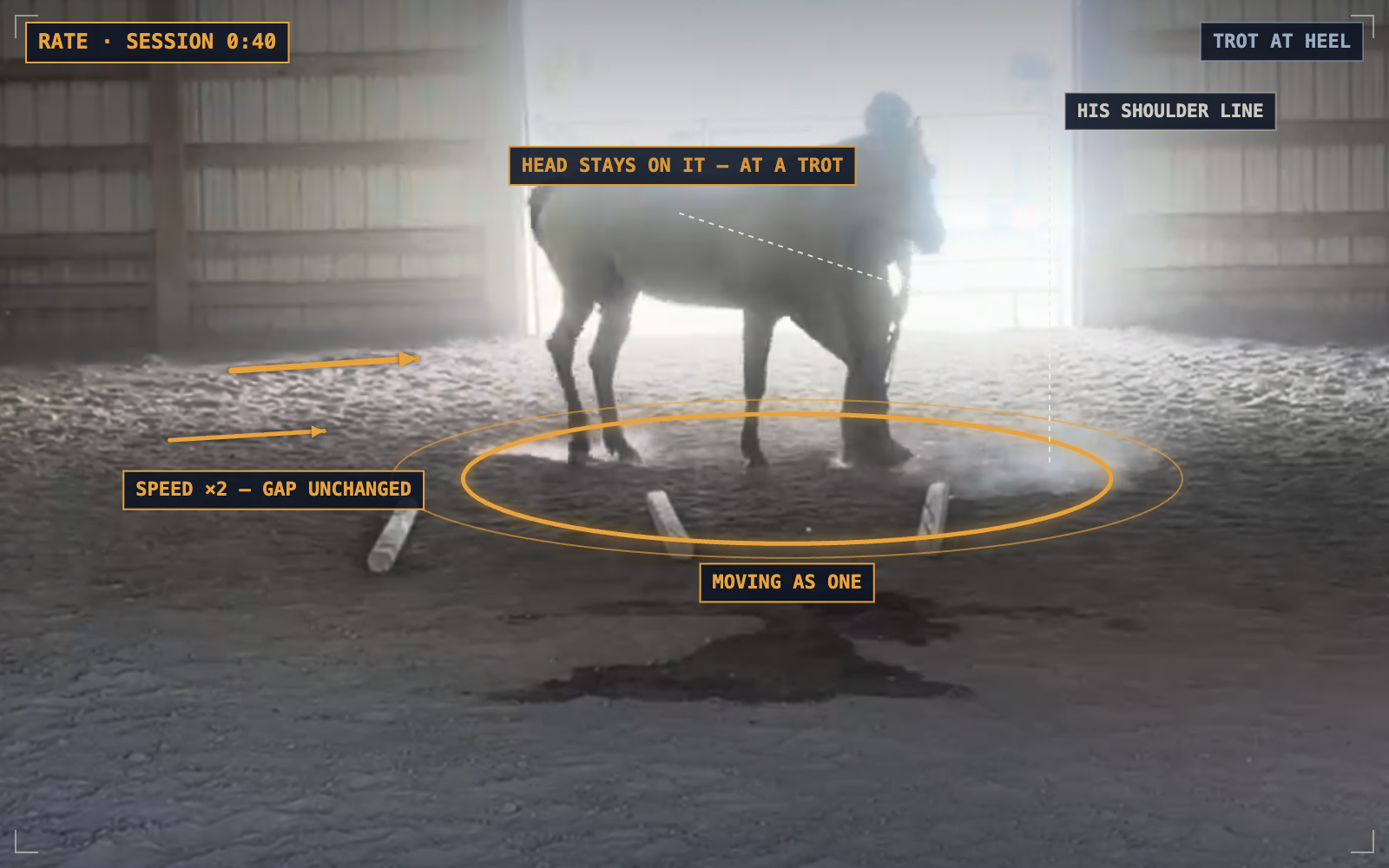
Rate — position held while speed doubles
He pitches into a jog and she lifts within a stride — head still on his shoulder line at twice the speed, then back down the moment his frame comes up. A nose chasing a treat cannot hold a body position through a gait change. A relationship can.
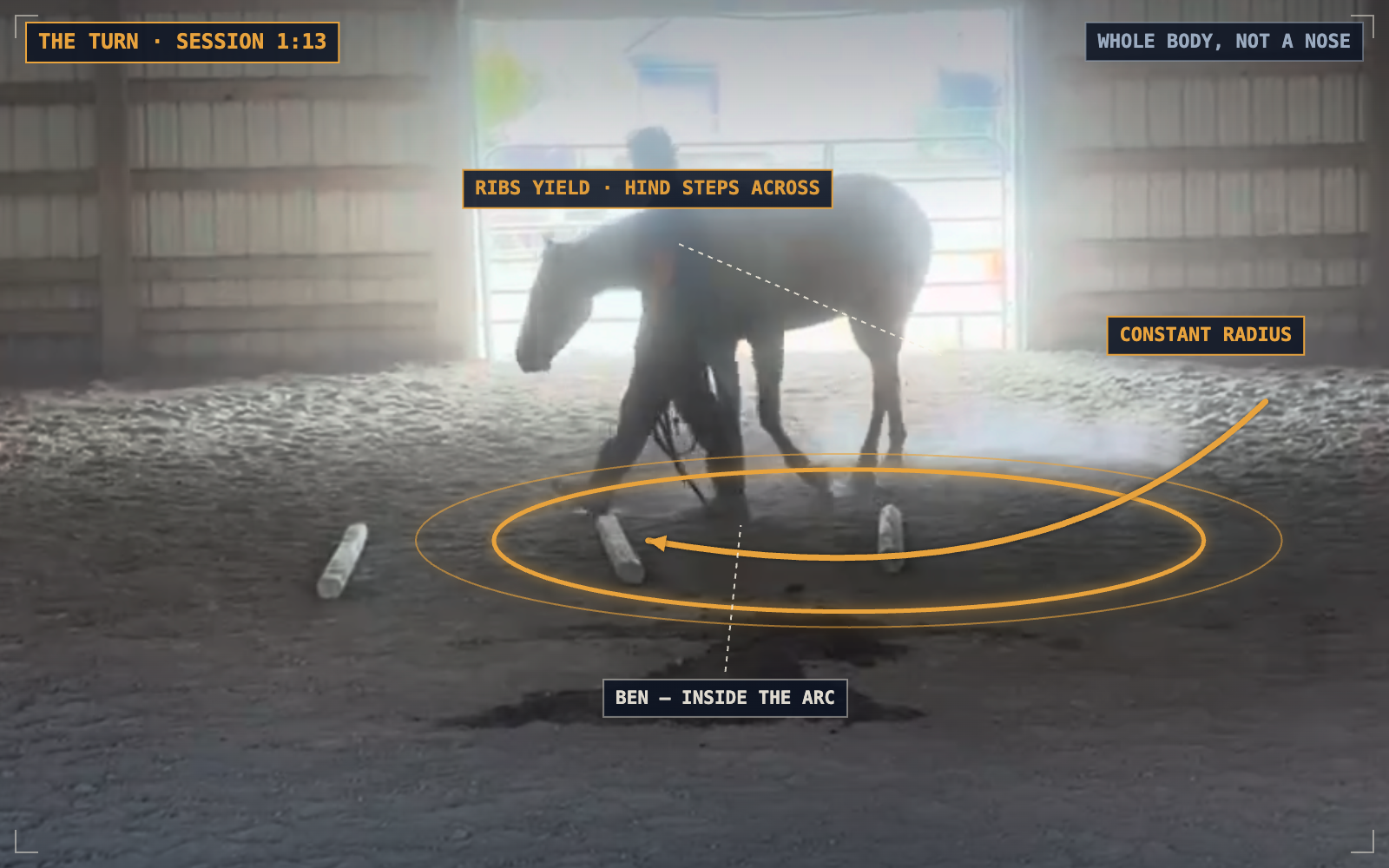
The turn — whole body, not a nose
Watch below the neck: ribs yield, the hindquarters step across, her spine rides the arc of his path with the radius constant. A lured horse bends its nose and drifts out. She turns everything.
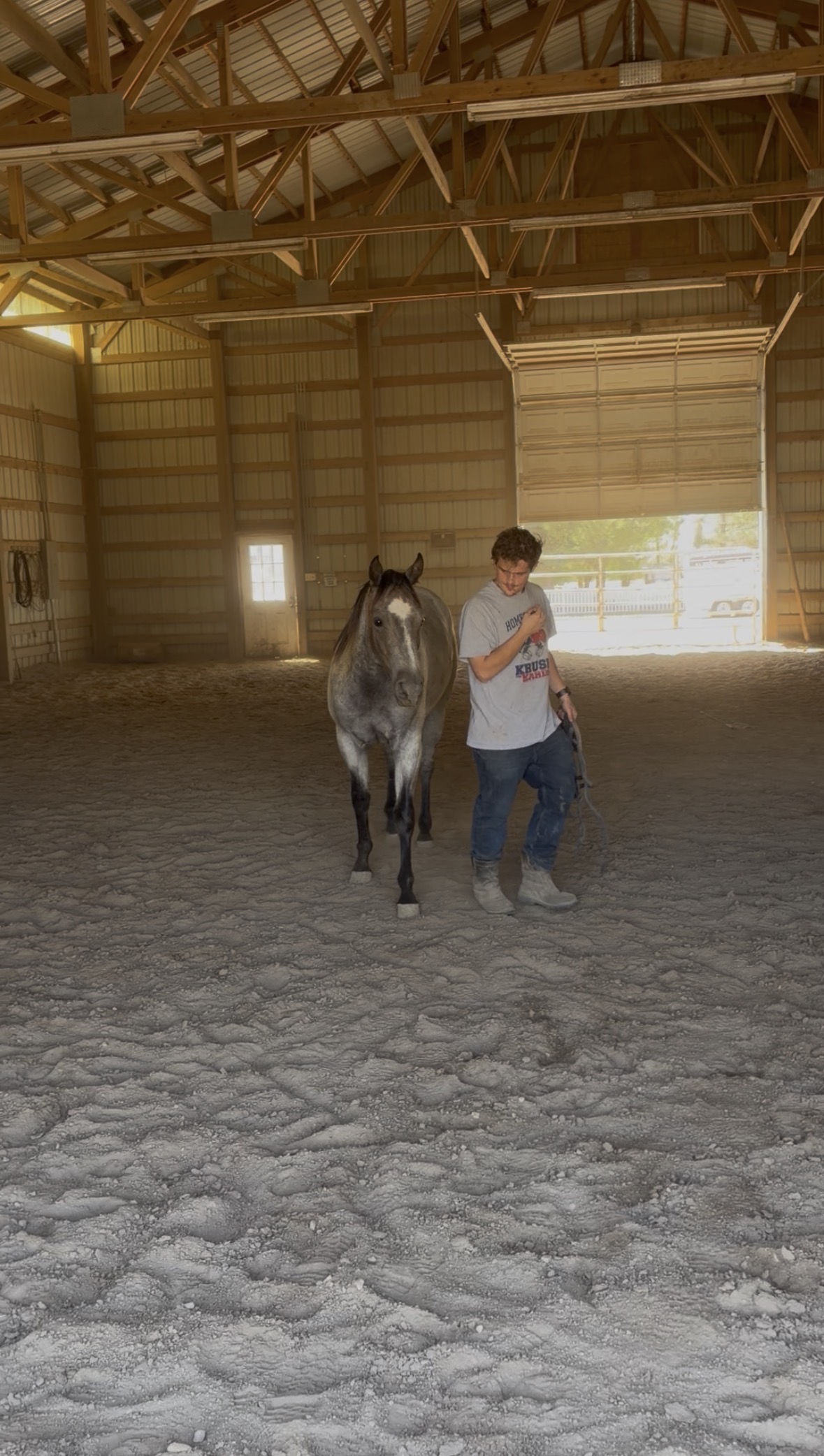
Pour Me Alil Scotch
"Scotch" — a buckskin roan AQHA filly, bred for cattle on both sides: foundation cow lines up top, Doc Bar and Peppy San cow sense underneath. Ben brought her home in May 2025, at ten months old. She has never been lunged into submission, never desensitized into dullness, never had a skill drilled into her from a rope's length. Everything she knows was built at Ben's side, at liberty, with her choosing every step — and she's two years old. She is the horse in every clip on this page, and the case the whole program is being proven on, in public, milestone by milestone.
Nobody else is building a horse this way toward a judged discipline: the liberty world doesn't aim at competition, and the cow-horse world starts from pressure. Scotch is the overlap — a cutting prospect whose every skill was chosen, not pressured — documented in public as she goes.
Watch her eye and her ears, not just her feet. A soft eye and ears tracking Ben mean she's thinking, not reacting — and that's why the work holds when things get loud. Under real pressure she stays predictable: the bolt in May was shut down in ten seconds because the relationship was already there to come back to.
This is not conventional training, and equal does not mean soft. I use force. I hold real authority. And she has a real vote — her expression is information, never an offense. All three hold at once because the relationship runs on one contract:
Everyone does groundwork — as preparation, from above, at rope's length. Mine is the relationship itself, built at heel from the rider's position: voice, hand, body, breath. Her body gets built there too — the so-called riding muscles are just working muscles, and correct work only comes out of the relationship. The saddle comes later; when it does, it inherits a partnership instead of starting a fight.
Day one with a fresh horse? A treat, a follow — and a boundary. Wanting the treat never buys crowding. The first thing the relationship contains is a line that holds.
A horse that stays with you when it counts.
Mid-session she dropped and rolled with me standing right there — the most vulnerable thing a prey animal can do. Then she got up, walked over, pressed her face to me, and held it. Twelve seconds.
You can't bribe that and you can't force it. It's what a horse does when it trusts you — and it's the thing every owner actually wants. It's on film.
Scotch's road to Fort Worth.
The 2027 NCHA Futurity takes three-year-olds that have never shown — so there's no highlight reel to sell you. The development arc is the proof.
I come to you.
Animals learn where they're comfortable, so the relationship starts in the stable your horse already knows. You don't haul anywhere, and you don't need an arena — at first, all the work needs is your stable and you. This is not a drop-off program: I train the pair, and you're in every session. Tell Rein below where your animal lives and you'll get a flat first-session price up front — drive included.
Two minutes with Rein, below — where you two stand, what's in the way, and a staged training plan for your horse. Yours to keep, free, whether or not we ever meet.
If you want a hand with stage one: I come to your barn and we work it with your horse — or, from anywhere, an hour over Google Meet with your horse on camera. Flat price up front either way.
Ongoing sessions at your stable, quoted flat and up front. You learn the same signals I use — voice, hand, body, breath — because the relationship being built is yours, not mine.
Ben Hamilton built the framework cross-species: proven first on Kodiak, a Giant Schnauzer trained through full task work and placed as a mobility-assistance dog — then built from scratch onto Scotch, the first horse to carry it. Everything on this page is the same method you'd be learning.
Start here. Tell me about your animal.
The relationship you have, or the problem you're stuck on — either one. Rein runs the same read I do: where you two actually stand, what's in the way — and a training plan for your horse that's yours to keep, free. If you want help working it, that exists too: me at your barn, or an hour over Google Meet from anywhere. Honest scope: it's a read from a description; the in-person evaluation governs.
The read was free. The evaluation is where you two start.
Ben comes to your barn — priced flat and up front, you in every session. The first thing you'll get in person is the same thing Rein gave you: an honest placement, what gets built first, and what the work will ask of you.